Table of Contents
- Taurine at a glance
- What Is Taurine in Energy Drinks, Exactly?
- Is taurine a stimulant?
- Why is taurine in energy drinks?
- What is taurine used for in the body?
- What is taurine made from?
- Is taurine made from bulls?
- Is taurine in Red Bull?
- Is taurine bad for you?
- Is taurine bad for your kidneys?
- Is taurine addictive?
- Taurine vs. caffeine: they are not doing the same job
- Where taurine fits into Drizz Energy Drops
- The bottom line
- Sources
- FAQs
What is taurine in energy drinks? Taurine is a naturally occurring sulfur-containing amino acid compound that your body already makes and that is also found in foods such as meat and seafood. It is not caffeine, not a stimulant, and not derived from bulls. Energy brands add it because taurine plays several roles in normal cellular function and has become a common part of modern energy formulas.
If you're trying to understand what is taurine in energy drinks, it helps to separate taurine from caffeine before looking at what the complete formula is designed to do.
Last updated October 3, 2026
Taurine at a glance
| Question | Short answer |
|---|---|
| What is taurine? | A sulfur-containing amino acid compound naturally present in the human body |
| Is taurine a stimulant? | No. Caffeine is the stimulant in most energy drinks |
| Is taurine made from bulls? | No. Commercial taurine can be produced synthetically |
| Why is taurine in energy drinks? | It is involved in normal cellular processes and is commonly included as a functional ingredient in energy formulas |
| Is taurine addictive? | Taurine is not generally considered an addictive stimulant |
| Is taurine in Red Bull? | Yes |
| How much taurine is in a 250 mL Red Bull? | Red Bull lists 1,000 mg per 250 mL serving |
| Does Drizz contain taurine? | Yes. Drizz Energy Drops list taurine alongside caffeine from green tea extract and L-theanine |
What Is Taurine in Energy Drinks, Exactly?
Taurine is often called an amino acid, although chemically it is more precisely an amino sulfonic acid. It occurs naturally throughout the body and is especially abundant in tissues including the brain, heart, retina and skeletal muscle.
Your body can make taurine from sulfur-containing amino acids, and you also get taurine through food. Meat, seafood and other animal-derived foods are common dietary sources.
So despite the futuristic name on an energy-drink label, taurine is not some exotic stimulant invented by the beverage industry. Your body was already using it before you opened the can.
Is taurine a stimulant?
No.
This is probably the most important misconception to clear up. Taurine is not caffeine and does not behave like caffeine.
Caffeine is a central nervous system stimulant. Taurine is not generally classified as one. Research evaluating taurine on its own has not supported the idea that it produces the same classic stimulant effect associated with caffeine.
One reason what is taurine in energy drinks gets misunderstood is that people assume every ingredient inside an energy drink must be another stimulant. That is not how taurine works.
If someone drinks a high-caffeine energy drink and feels wired, shaky or unable to sleep, the caffeine dose deserves plenty of attention before taurine gets blamed.
Why is taurine in energy drinks?
Taurine participates in several biological processes, including cellular water balance, calcium signaling and normal muscle and nervous-system function. Those roles made it an interesting ingredient for functional beverages, and over time taurine became one of the signature ingredients associated with the energy-drink category.
When people ask what is taurine in energy drinks doing there, the most accurate answer is that taurine functions as part of the broader formula rather than as a second source of stimulation.
There is an important difference between saying:
- Taurine has real biological functions.
- Taurine definitely makes caffeine work better.
The first statement is well supported. The second is much harder to make confidently.
A recent systematic review examining caffeine, taurine and combinations of the two found that evidence around their combined effects remains inconclusive.
That means taurine should not be treated as a secret second stimulant or a scientifically guaranteed caffeine amplifier.
The more accurate view is that taurine is a real physiological compound with legitimate biological roles and a long history in energy-drink formulas, while research on its specific interaction with caffeine is still developing.
What is taurine used for in the body?
Researchers have studied taurine for decades because it appears throughout the body and participates in a broad range of physiological processes.
Among the areas commonly discussed in the scientific literature are:
- cellular water and electrolyte balance
- calcium signaling
- bile-acid conjugation
- nervous-system function
- retinal function
- muscle-cell function
- cell-volume regulation
That does not mean drinking taurine produces a dramatic, immediately noticeable effect in the way caffeine can.
Caffeine has a clear stimulant mechanism. Taurine's physiology is broader and less like flipping an “energy” switch.
What is taurine made from?
The human body can synthesize taurine from sulfur-containing amino acids including cysteine and methionine. Taurine is also naturally present in foods, particularly animal-derived foods such as seafood and meat.
Commercial taurine used in beverages and supplements can be manufactured synthetically. That means modern energy-drink taurine does not need to be extracted from animals.
Is taurine made from bulls?
No.
The rumor probably survives because the name taurine traces historically to the Latin word taurus, meaning bull.
But modern commercial taurine does not need to come from bulls. Red Bull explicitly states that the taurine used in its products is synthetically produced and is not derived from bulls or other animals.
So no bull semen. No bull testicles. No mysterious animal extract.
Just chemistry with an unusually persistent rumor attached to it.
Is taurine in Red Bull?
Yes. Taurine is one of the ingredients most closely associated with Red Bull and with energy drinks generally.
Red Bull is also a major reason what is taurine in energy drinks became such a common consumer question in the first place.
On its official ingredient information, Red Bull lists 1,000 mg of taurine in a 250 mL serving. The company also describes taurine as a compound naturally present in the body and involved in cellular water and electrolyte balance.
That helps explain why consumers began associating taurine so strongly with “energy.” Red Bull helped make the ingredient famous.
But the caffeine is still the stimulant.
Is taurine bad for you?
Calling taurine simply “good” or “bad” is not especially useful.
Taurine is naturally present in the body and in normal foods. Scientific and regulatory evaluations have not treated ordinary taurine exposure from energy drinks as inherently toxic.
From a safety perspective, answering what is taurine in energy drinks requires looking at the dose and the complete product rather than treating the ingredient name itself as evidence of danger.
The European Food Safety Authority has previously evaluated taurine exposure from energy drinks and did not identify a safety concern at the exposure levels it assessed.
That does not mean every energy drink, every serving size or every pattern of consumption is risk-free. Energy drinks can contain substantial amounts of caffeine, and caffeine can contribute to effects such as insomnia, nervousness or a racing heartbeat in some people.
Those concerns involve the complete beverage, the caffeine dose, the amount consumed and individual sensitivity. They should not automatically be attributed to taurine alone.
Is taurine bad for your kidneys?
This is another question where the scary version of the answer is not necessarily the useful one.
The kidneys play an important role in regulating taurine balance in the body, and research describes interactions between taurine and normal kidney physiology. That is different from establishing taurine as inherently harmful to healthy kidneys.
However, someone with kidney disease or another medical condition should not assume that concentrated supplements or energy products are appropriate simply because taurine also occurs naturally in the body.
If you have kidney disease, take medications affecting kidney function or have been advised to restrict supplements, talk with your healthcare professional about taurine-containing supplements or energy products.
Is taurine addictive?
Taurine is not generally considered an addictive stimulant.
It does not produce the classic stimulant mechanism associated with caffeine, nicotine or amphetamine-type compounds.
Caffeine is different. Regular caffeine use can produce tolerance and withdrawal symptoms in some people.
So “taurine is in an energy drink” does not mean “taurine is what makes energy drinks habit-forming.”
Taurine vs. caffeine: they are not doing the same job
| Feature | Taurine | Caffeine |
|---|---|---|
| Naturally present in the body | Yes | No |
| Found naturally in foods | Yes | Yes, especially coffee, tea and cacao |
| Central nervous system stimulant | No | Yes |
| Produces the classic alertness effect | Not in the way caffeine does | Yes |
| Common in energy drinks | Yes | Yes |
| Research on the combination | Still developing; combined effects are not fully settled | |
This distinction is useful when reading an energy-drink label. Caffeine tells you much more about the immediate stimulant load. Taurine tells you something about the broader formulation.
Where taurine fits into Drizz Energy Drops
Drizz takes a different approach from the traditional canned energy drink.
Instead of selling another flavored beverage, Drizz Energy Drops add the functional ingredients to a drink you already chose.
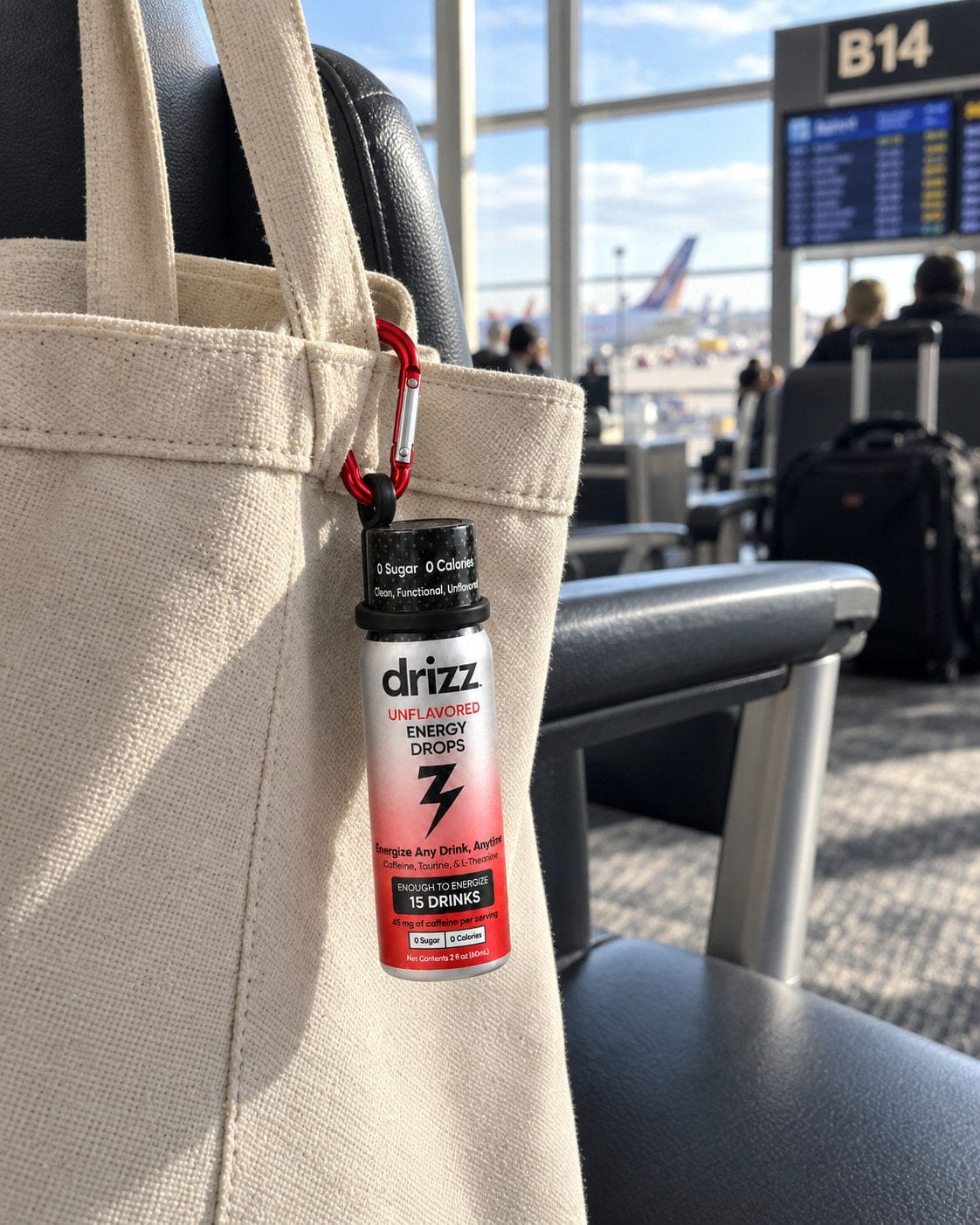
For Drizz, answering what is taurine in energy drinks means being clear about taurine's role alongside caffeine and L-theanine rather than pretending all three ingredients do the same thing.
One squeeze contains 65 mg of caffeine from green tea extract, plus L-theanine and taurine, with zero sugar and no added flavor. The drops are designed to go into water, coffee, tea, sparkling water, smoothies and other drinks with minimal taste change.
The straightforward way to explain the formula is:
- Caffeine is the stimulant.
- L-theanine is commonly studied alongside caffeine.
- Taurine is a functional ingredient with established physiological roles, while research on its specific synergy with caffeine is still evolving.
Drizz includes taurine as part of an energy-style ingredient stack, but the most measurable energy input in the formula remains the 65 mg of caffeine per squeeze.
For more on the unflavored format, read Why Our Energy Drops Have No Flavor (On Purpose).
You can also read Clean Energy Drink Alternative: Add Energy, Keep Your Drink or compare Drizz with another caffeinated water enhancer in Drizz vs MiO Energy.
Drizz Energy Drops – Unflavored Liquid Energy, Sugar-Free with L-Theanine, Taurine, and Caffeine from Green Tea
$12.99
$14.99
Drizz Unflavored Energy Drops are liquid energy drops, also called caffeine drops, that you add to water or soda. One squeeze is 4ml and 65mg of caffeine from green tea, plus L-theanine and taurine. No sugar, no added flavors, 15… read more

The bottom line
So, what is taurine in energy drinks?
It is a naturally occurring amino-acid compound that your body already contains and that plays legitimate roles in normal cellular physiology.
- It is not caffeine.
- It is not a stimulant.
- It is not made from bulls.
- It is a common functional ingredient in energy-drink formulas.
The science does not justify treating taurine as a guaranteed performance enhancer or a magical partner to caffeine. But it also does not make sense to treat it like a mysterious danger simply because it appears on an energy-drink label.
For Drizz, taurine sits alongside L-theanine and 65 mg of caffeine from green tea extract in a concentrated format designed to let you add energy to the drink you already chose rather than opening another can.
See Drizz Energy Drops, ingredients and serving directions.
Sources
- PubChem: Taurine
- Systematic review of caffeine, taurine and their combined effects
- Research examining taurine and stimulant activity
- Red Bull ingredient information
- Red Bull: Is taurine made from bulls?
- European Food Safety Authority: Taurine and energy drinks
- Drizz Energy Drops product page
FAQs
What is taurine in energy drinks?
Taurine is a naturally occurring sulfur-containing amino acid compound found in the human body and in foods such as meat and seafood. In energy drinks, it is commonly included as a functional ingredient alongside caffeine, but taurine itself is not a stimulant.
Why is taurine in energy drinks?
Taurine is involved in normal processes including cellular water balance, calcium signaling and muscle and nervous-system function. Energy drink brands include it as part of the broader formula, although research has not established taurine as a guaranteed enhancer of caffeine’s effects.
Is taurine a stimulant?
No. Taurine is not considered a central nervous system stimulant like caffeine. In most energy drinks, caffeine is the ingredient primarily responsible for the immediate stimulant and alertness effects.
What is taurine made from?
The human body can make taurine from sulfur-containing amino acids, and taurine also occurs naturally in foods such as meat and seafood. Commercial taurine used in beverages and supplements can be manufactured synthetically.
Is taurine bad for you?
Taurine is naturally present in the human body and in everyday foods, and current evidence does not support treating taurine itself as inherently harmful at ordinary dietary or energy-drink exposures. The complete product, dose, caffeine content and individual health circumstances still matter.
Is taurine bad for your kidneys?
Research does not establish taurine as inherently harmful to healthy kidneys. However, people with kidney disease or other medical conditions should speak with a healthcare professional before using concentrated taurine supplements or energy products.